| Photojournal
- 9 and 10 August 2007
Something fishy
I had gotten a bit irritated with how long my camera and lenses had been in the shop. With summer getting to be half over, I was missing out on some of the better photography days in the year. It was like a hole had been punched in the fabric of my usual life.
So, perhaps predictably, I tried to fill the hole by buying new pieces of equipment to play with. This explains why I had ordered a fisheye lens. On the 9th, it arrived.
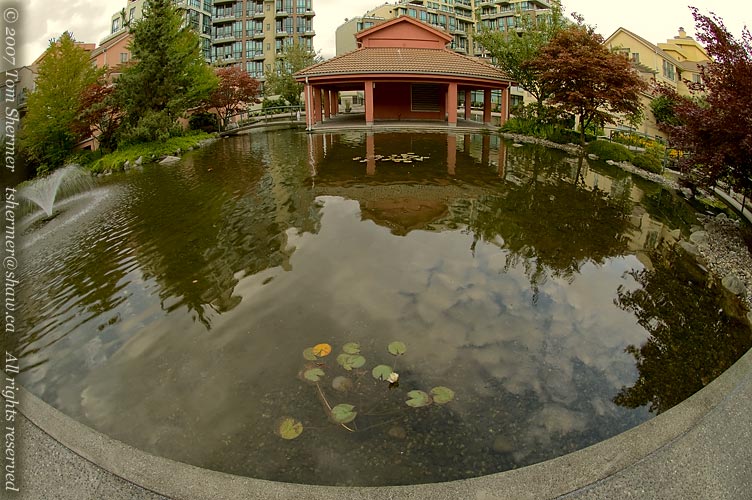
Fisheyes are very special-purpose lenses; they give the widest angle of all usual lens types, but make no attempt to correct barrel distortion. This gives photos taken with them a characteristic look, where many of the world's straight lines appear curved.
Here's one of my first shots with the lens, showing just that effect. The pond edge at the bottom of the photo, for example, is straight in real life. |
|
 |
I played with a few different compositions in the courtyard, trying to familiarize myself with the lens, but I wound up with a lot of similar-looking shots.
Next I went out by the river and found a view where I got both the building on the left, and the lamppost on the right, to menacingly curve towards the walkway. |
|
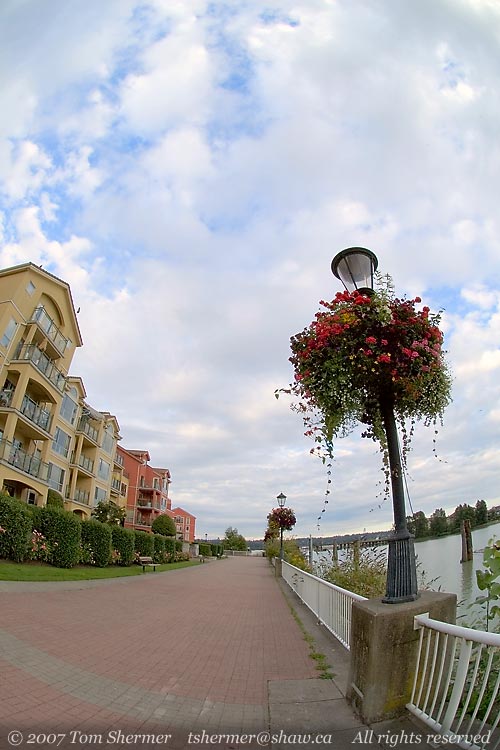 |
That was different, at least. I can see where that kind of effect could be put to good use in a photo.
I had fun just looking through the camera at the distorted world for a while. I walked along the building to our waterfall, where the building bulged forth at me. |
|
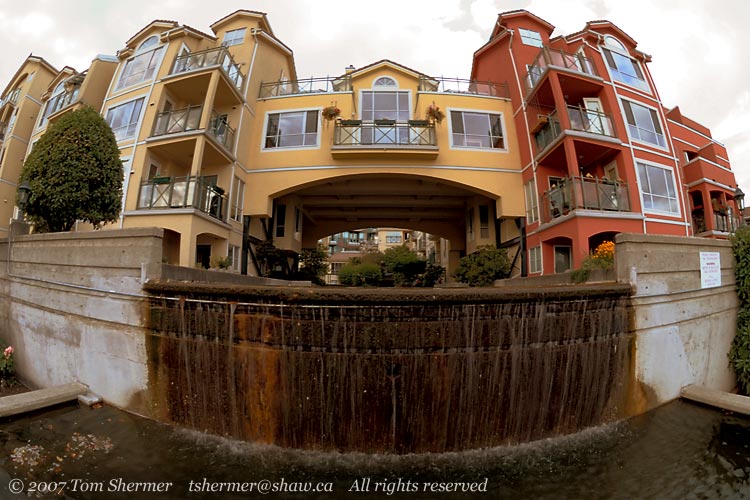 |
| I have some software from Nikon that will undistort a photo taken with this lens. When I run it on the above photo, I get the following. |
|
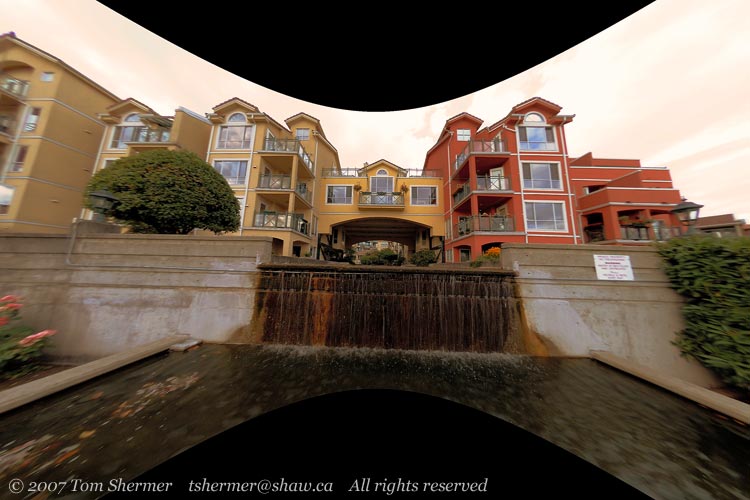 |
In that version, note just how tilted to the right the bulding and waterfall are. I was being very careful and trying very hard to keep everything level and upright, but that turned out to be quite a difficult task. I'm going to need more practice at it.
Anyhow, here's a third version, in which I rotated the second version and cropped it to the center portion. It's still a bit skewed, but it's got straight lines. |
|
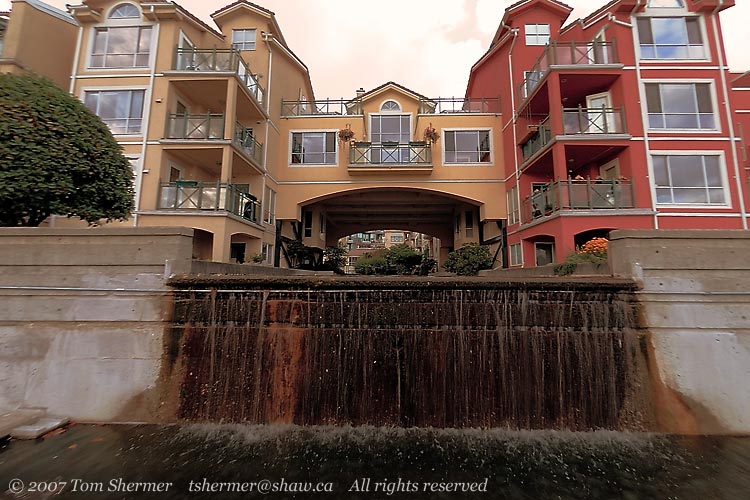 |
Of course, that's not the point of fisheye; to me, in fact, it pretty much defeats the purpose. A standard wide-angle would do a better job of a photo like that. So I'll stick with the curved appearance of fisheye photos, and not mess with the straightening software much.
One of the good uses of a fisheye (or other wide-angle) is for storytelling or detail-in-context photos, where a main subject is presented with layers of context (surrounding elements) around it.
Here's an example of such a shot. The rose on the right is the subject, but you also get the context of the leaves behind it, the other roses behind, and the ones to the left, the cement wall, and the building. |
|
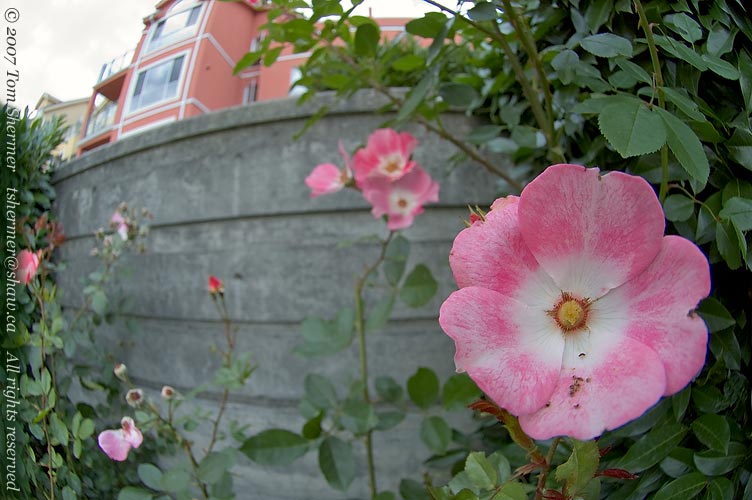 |
That sort of shot isn't possible with a long lens. To get all of those elements in a longer-lens shot, one has to back off the subject further, and so its relative importance in the photo is diminished. A longer-lens version would be more "some roses by a wall in front of a building" (or worse, "a building with a wall and roses in front of it") rather than "this rose by these other roses by this wall by this building".
A fisheye will compress a lot of stuff into a single photo; in this way, it's quite the opposite of a macro lens, which fills a photo with very little stuff. That being the case, I had to try out my new fisheye on something that I would normally use my macro lens for. So here's a fisheye view of a fly. |
|
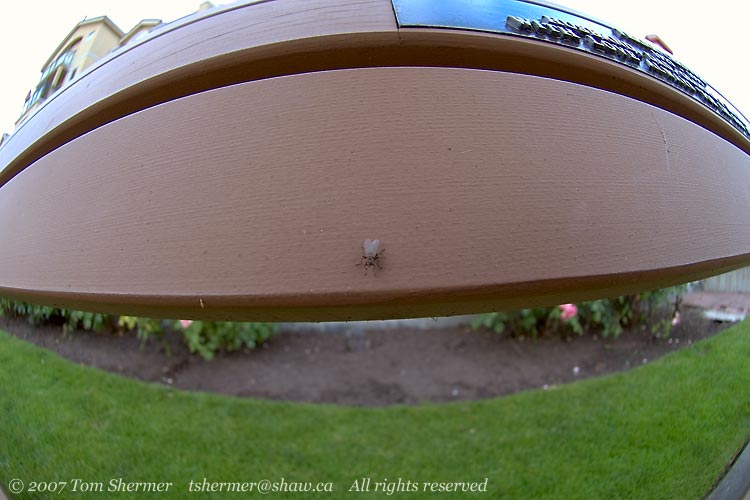 |
If you can't tell, that fly is on a park bench. I like how the slats of the back of the bench became those huge curved brown things in the photo. And the fisheye really shows its character by providing lots of context (the building, the flowers, the plaque, etc.)
But I wasn't able to get that much detail on the fly, unfortunately. When I tried to move the camera in closer, the fly flew away. After a few attempts, I decided that if I wanted the fly to fill more of the frame, then I should really get the macro lens out.
So I went back inside and changed the camera to the macro lens, then went hunting for bugs. I found a few, as you'll see below. I also went out the next day and got a few more; since they were similar subjects I grouped them all together in this entry.
My first find was a little stinkbug nymph. This fellow's yellow fringe indicates that he's in the genus Chlorochroa. The coloration and range information leads me to believe that he's a Conchuela, also known as C. ligata. |
|
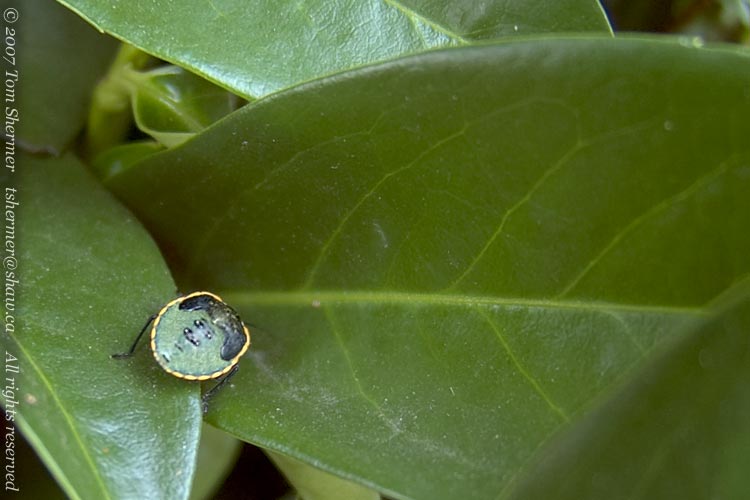 |
Lovely colors on the little guy.
My second find was someone's discarded exoskeleton, or at least part of it. The long "pincers" at the top remind me of earwigs, which we have a few of. So I'd guess that this was from the rear (abdominal) portion of an earwig. |
|
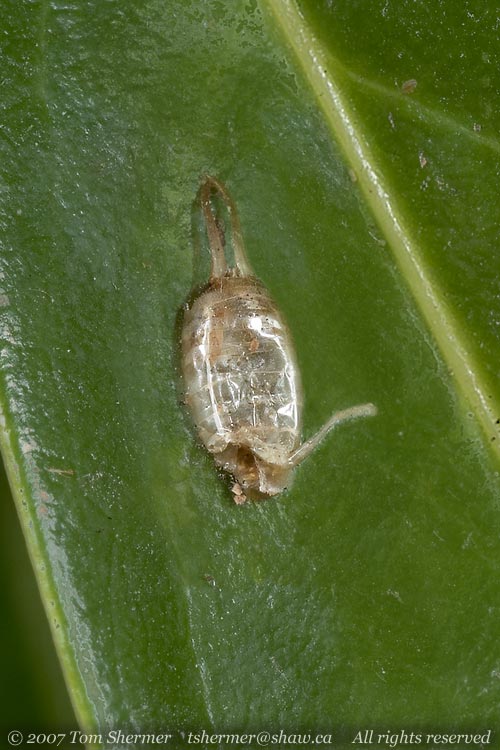 |
The most common earwig we seem to have around is the European Earwig, Forficula auricularia. However, their abdomens seem a bit more boxy (less curved) than the one above...so I'm not 100% sure of my guess.
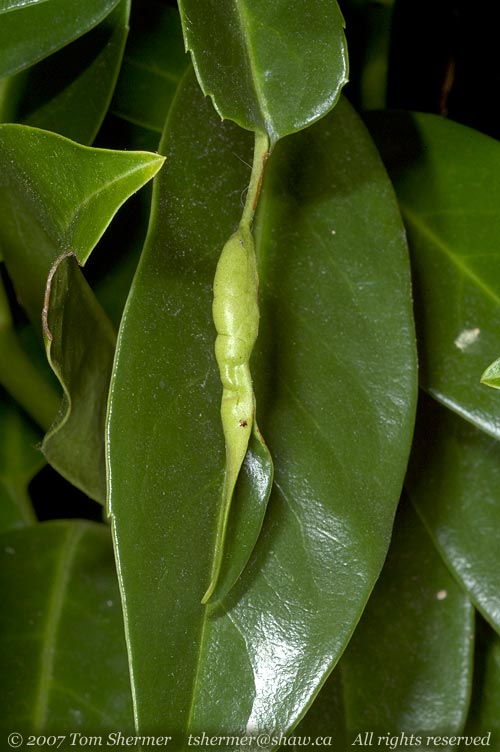
It's interesting what one can find if they look closely at leaves...so far we've got bugs and their shed skeletons...next up is a cocoon of some sort. In order to save on silk or other self-generated wrapping, some bugs and spiders make cocoons using found materials. Whoever made the cocoon below ate off most of the middle part of the leaf, and then wrapped some of the lower part together (using silk or some internally-generated glue) to form the cocoon. Then all it had to do was plug the end (after laying eggs and/or crawling in). |
|
 |
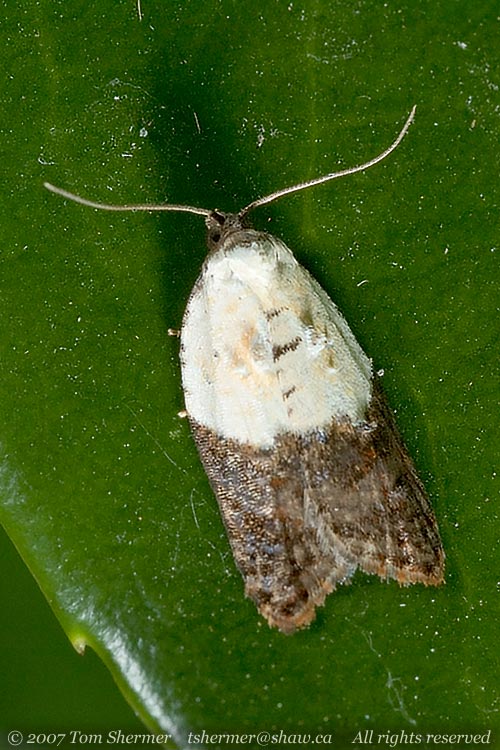
| My next subject was a moth. This one was about a centimeter long and there were many of these all over our laurel bushes. They seemed to be only around for a few days, but I've seen them for a couple of years now. I've yet to be able to identify them, but maybe one year I'll figure them out. |
|
 |
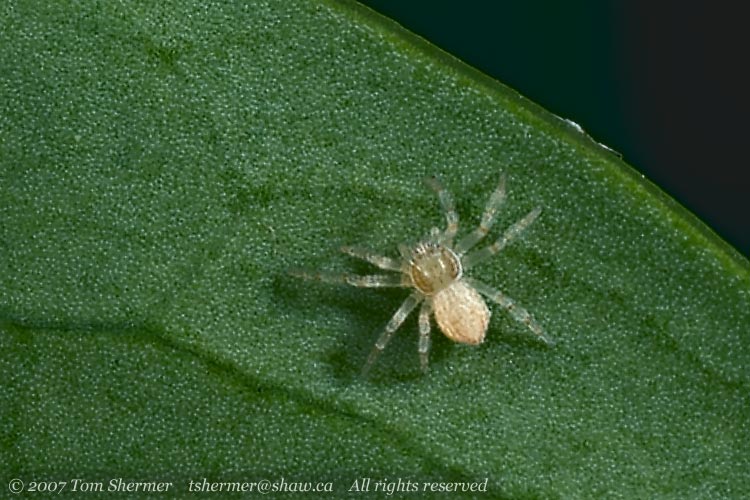
| Subjects from the 10th included a light-colored (and seemingly partially transparent) little spider, |
|
 |
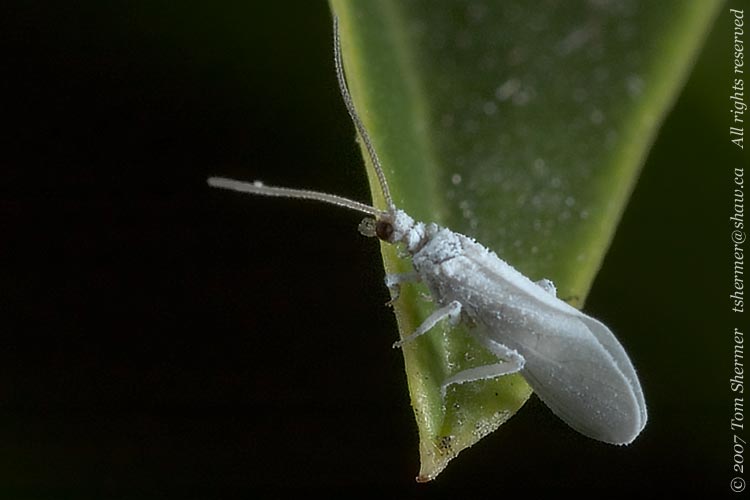
| a Dustywings that let me get in real close, |
|
 |
| and a Harvestman that did the same. |
|
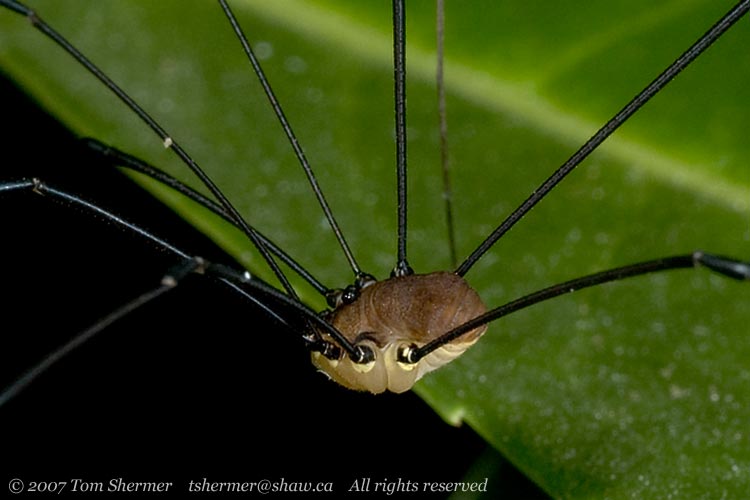 |
Close followers of the photojournal will know that harvestmen are like spiders, but that they have only one body section, not two. Most of the things I find around my condo that look like a "daddy long-legs" spider turn out to be harvestmen.
Pondering fish's souls,
Tom |
|
|