| Photojournal
- 14 July 2007
Plovin' it
The 14th of July was a Saturday, and I was waiting for it. On Thursday afternoon, my pal Carlo had been out at Boundary Bay, looking through his scope, and he had found what looked to be a Lesser Sand-Plover, which is an asian shorebird that is fairly unusual for these parts.
On Friday, Carlo went back out with Ilya in tow, and they scoured the bay until they relocated the bird and confirmed that it was indeed a Lesser Sand-Plover. And since I had never seen one of these beauties, I made plans to go out to the bay to try to find it. High tide would be the best time to look, and the best high tide was early in the morning.
When Saturday morning arrived, I actually woke up earlier than I had planned, and decided to get myself out to the bay rather than rolling back over. I left my condo around 4:45, and found my first bird before I even made it down to the garage. In the dim morning, a Great Blue Heron was sitting on a rock in our courtyard lagoon, admiring the water fountain. |
|
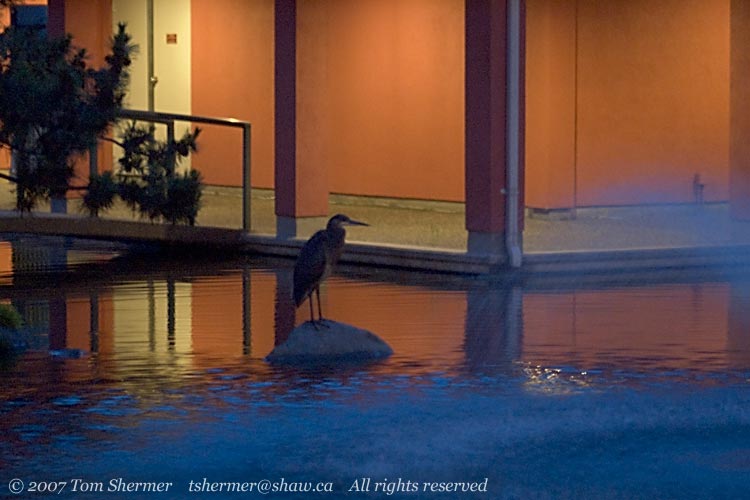 |
Or more specifically, he was admiring the water fountain while taking a break from eating the little fish in the lagoon.
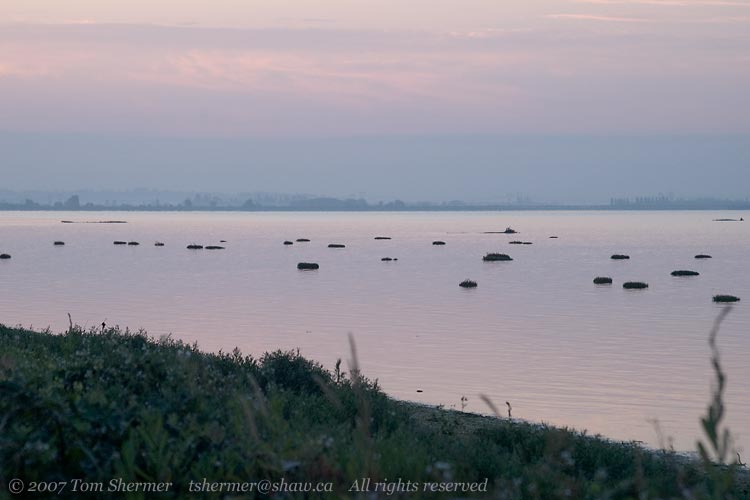
After stopping for coffee and an Egg McMuffin, I made it to the bay around 5:30. I parked on 104th Street and made my way up to the dyke. I was the first one there, and it was nice having the place to myself. The chill and the pink-and-lilac early-morning light was very calming. |
|
 |
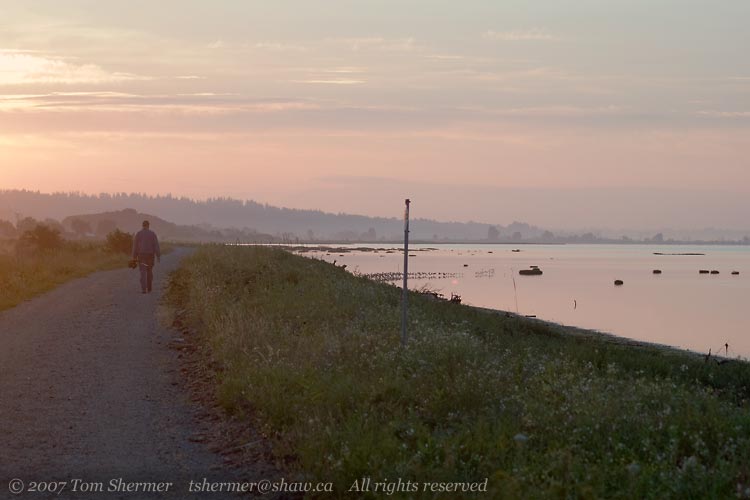
| In ten minutes or so, I was joined by another birder, a fellow I'd never met before. After a brief conversation, he headed off eastward on the dyke, and all was still once more. |
|
 |
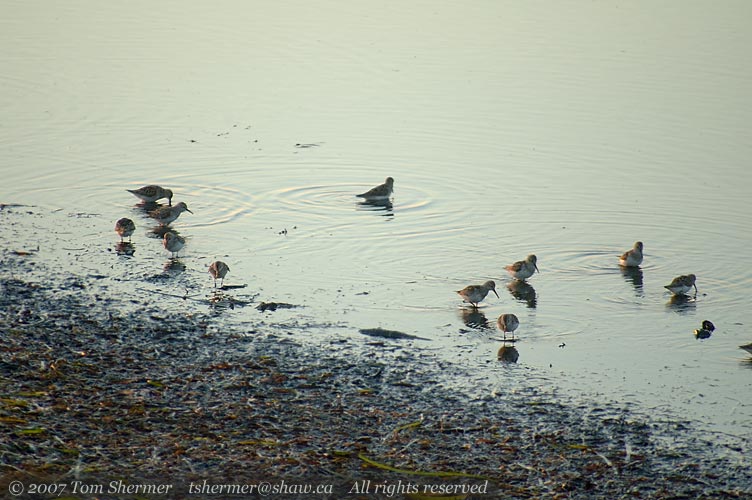
| There was a little bit of activity at the water's edge near where I was. A group of peeps—my impression of them is Western Sandpipers—was foraging there. |
|
 |
| Another bunch of peeps burst from the water's edge a bit further along, and flew around in a tight-knit group. |
|
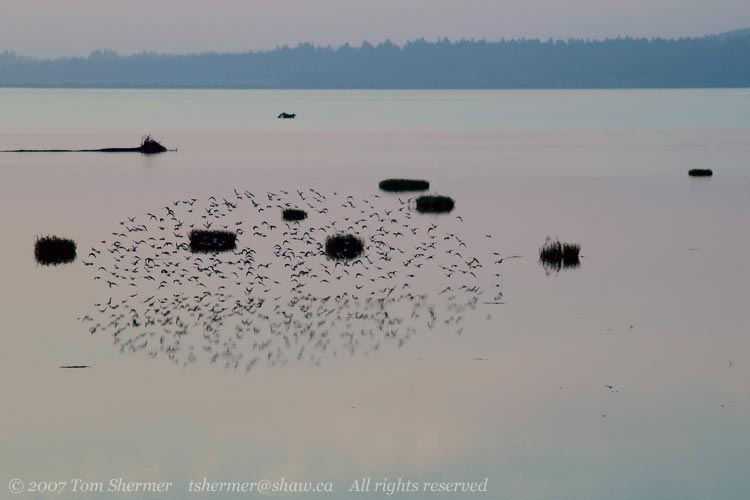 |
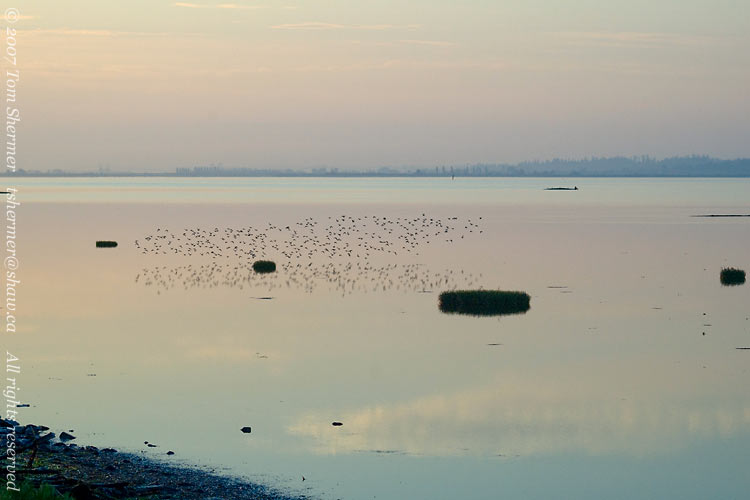
| They were joined by even more birds; sometimes I'm surprised at just how many birds can be hidden along a shoreline. |
|
 |
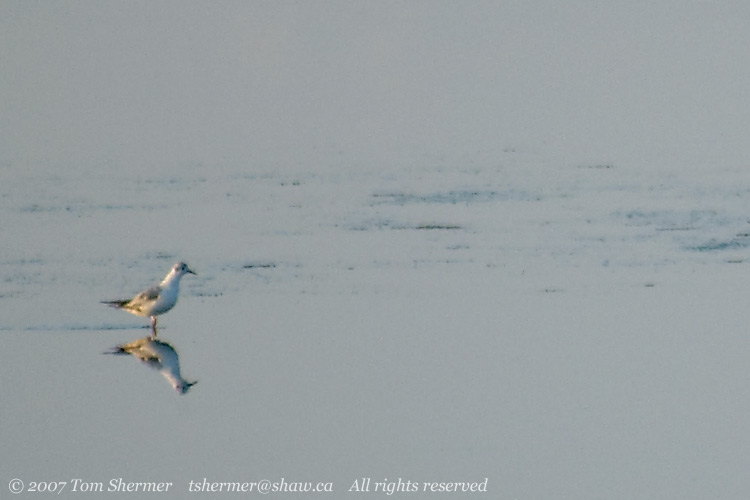
Next I found a Bonaparte's Gull a good distance out on the water. His rear end seemed gold, which was an odd sort of thing. I think it was some sort of trick of the morning light, as it's certainly not his normal plumage color. |
|
 |
| Soon thereafter I caught a Great Blue Heron flying in...here he has just landed. You can see a few shorebirds a little further out in this photo. |
|
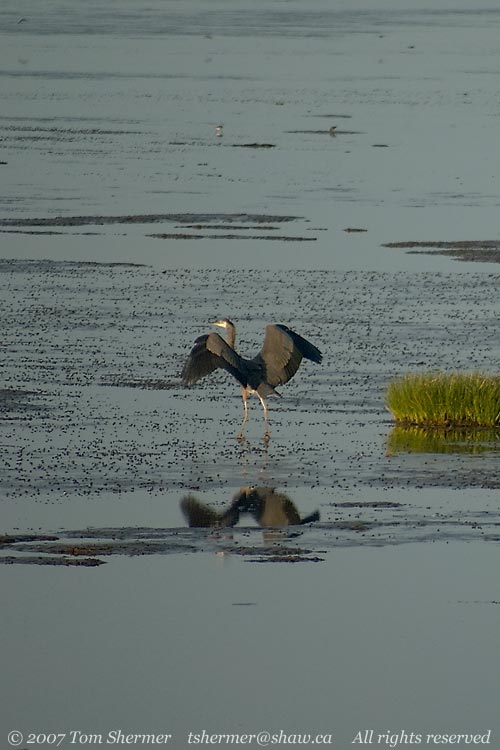 |
And all the little dark lumps in the water in that photo are lugworm burrows. The lugworms eject mud when they dig in, each one making a little spaghetti-mound in the bay.
Soon many more birders arrived, looking for the wayward plover. Some of them did a quick scan through their scopes, but mostly it seemed that they were talking. I tired of this relatively quickly, and figured that we might do better spread out rather than bunched up. So I walked a ways up the dyke, and set my scope up there. Normally I don't carry both camera and telescope, as something that is far enough out for me to need the scope to see is too far out to get a decent photograph of. But this wasn't a normal day, and I had both of them along.
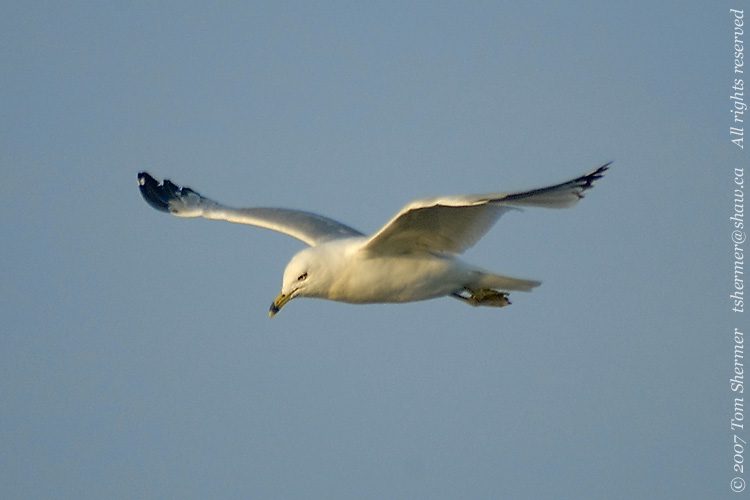
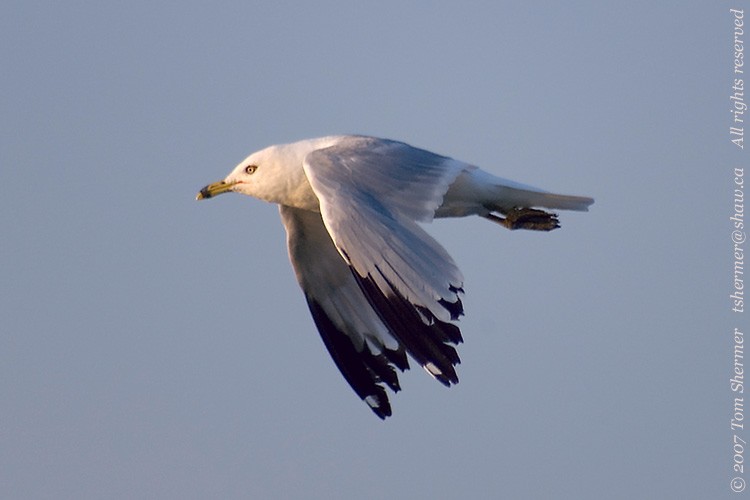
I scanned for a while through the scope, and didn't find the plover in question. But I kept looking. Around 6:30 I put my camera back on the tripod and got some photos of a Ring-Billed Gull who flew over. |
|
 |
| |
|
 |
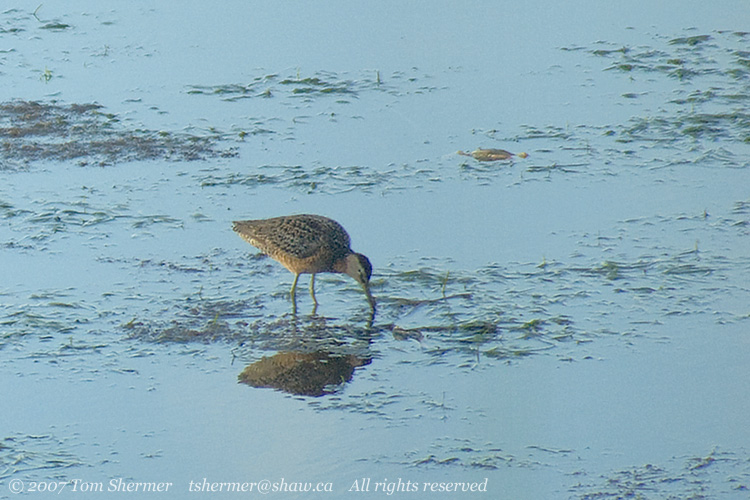
| The wait and search continued...around 7:30, after two hours at the dyke, I found a Long-billed Dowitcher fairly close in. |
|
 |
A little after 8:00 one of the people broke off from the group of birders further down the dyke and came down my way. She told me that the group had located the bird, and so I grabbed my gear and headed down to where they were. It was mighty kind of her to come out to me (and some other folks farther along) to let us know that the bird had been spotted.
Once I was with the main flock of birders, they pointed out the plover to me, and I soon had him acquired in my telescope. I watched for about five minutes, and was able to see reasonable detail (the bird was clearly a plover with some black on the head, for instance). I also saw flashes of his white throat and cinnamon-colored breast when he stood erect. So, despite the distance, I was certain of the bird. (Of course, having about ten more-experienced birders agreeing helped with the identification.)
Anyhow, I was able to get a photo of him...and in case you couldn't pick him out, I put a red circle around him. |
|
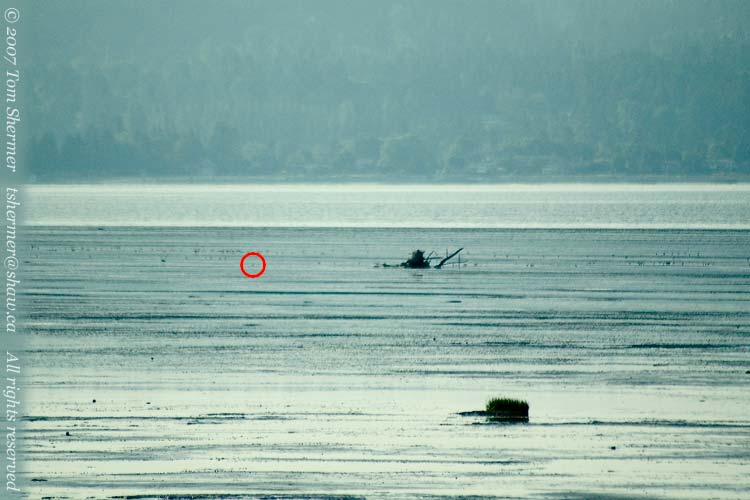 |
I'm not kidding...that really is the Lesser Sand-Plover. And that's the best my gear would do. It didn't help that my best stuff was still in the shop.
It turned out that the group had seen the bird about 20 minutes before I got fetched, and the bird had been closer in. So if I would've stayed with them, I might've gotten better photos. Sometimes it pays to stay with the herd, and sometimes it pays to split off. The problem is that it's really hard to tell which to do at any given moment. Win some, lose some, I guess.
Anyhow, I was happy that I at least got to see the bird, even if the photos didn't show anything but a few dark pixels.
Around 8:45 or so I packed up and headed home for a well-deserved nap. Later in the day I got one more photo, a beautiful green moth I found on the outside wall of my condo. |
|
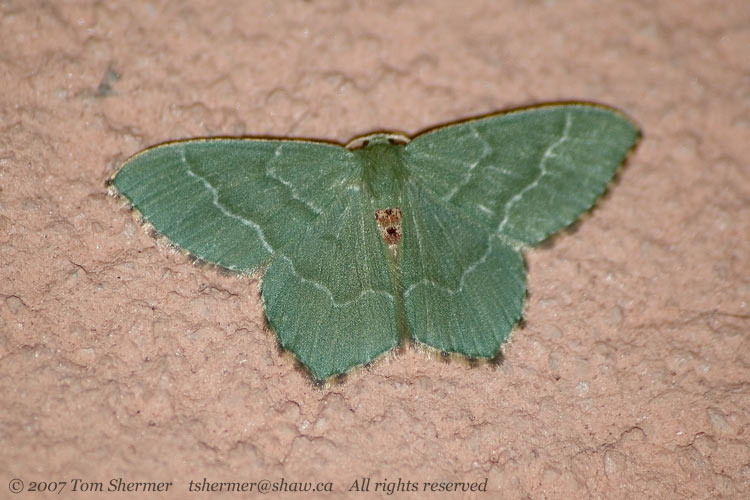 |
That fellow is a Common Emerald, or Hemithea estivaria to those of you that speak Latin. Some folks just call 'em 7083, but it's a shame to reduce such a beautiful creature to a number.
Lookin' for plove in all the wrong places,
Tom
|
|
|