| Photojournal
- 8 July 2007
Bill Curley
The eighth of July was a hot day. In the evening, it cooled down a little, and I felt like getting outdoors. So I grabbed my spare camera gear (the good stuff was still in the shop) and took the drive down to Blackie Spit, where I was hoping to meet a fellow named Bill Curley.
Now, summer generally isn't the best time for birding in these parts, but I was still optimistic as I set out. I walked out to the end of the spit and back without finding much. Then I headed over to the Savenye protected area. When I got to the part that looks out towards the community gardens, I found a small gull sitting on the old pilings.
|
|
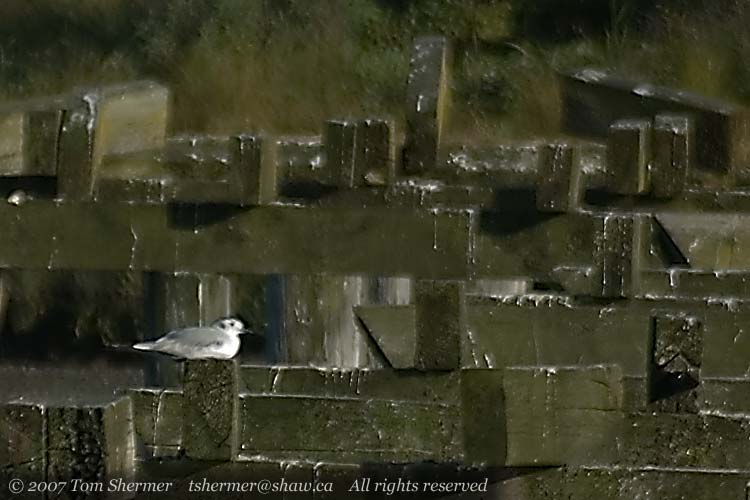 |
The black spot on the back half of his head identifies him as a Bonaparte's Gull.
The most common small gull at Blackie is the Ring-Billed Gull, and I had almost dismissed this fellow as one of them. It was a good thing I actually took a second to look at him, as a Bonie is a pretty good bird for me. This was a good start to my outing.
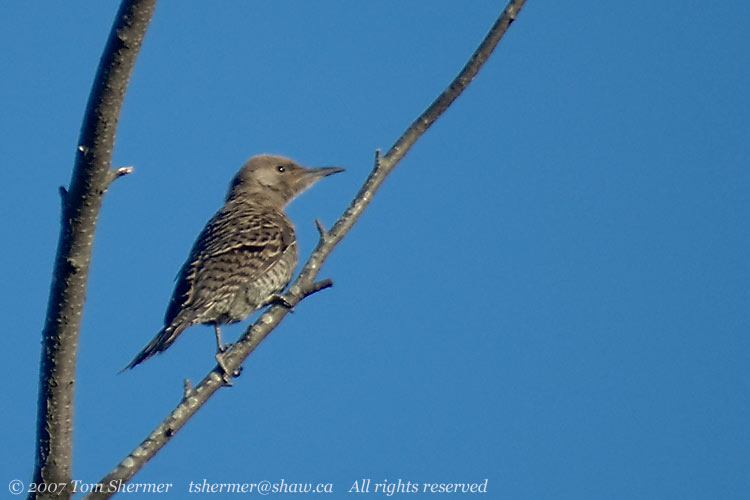
A couple of minutes later, near the entrance to the Savenye area, I caught a grey-brown lady up in a tree. She was a Northern Flicker, one of the drabbest, plainest Northern Flickers I've ever seen.
|
|
 |
| When she flew, though, I got a small glimpse of her color. |
|
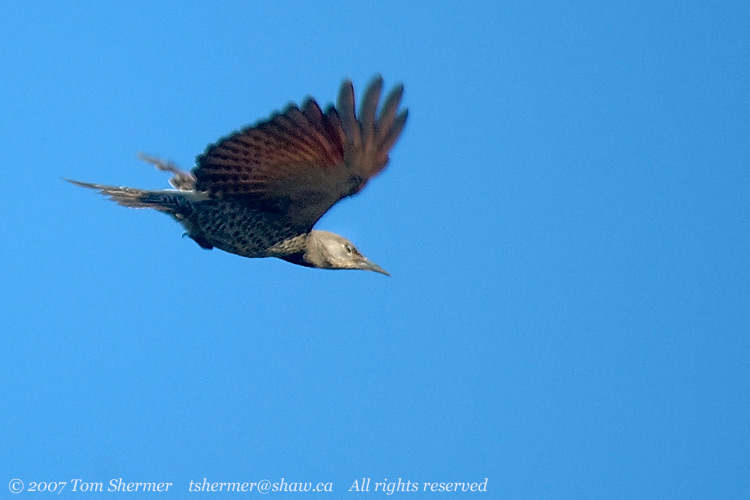 |
But she never really turned to an angle where I got to see her underwings in all their glory. In bright light, at the right angle, Flicker underwings can be quite spectacular.
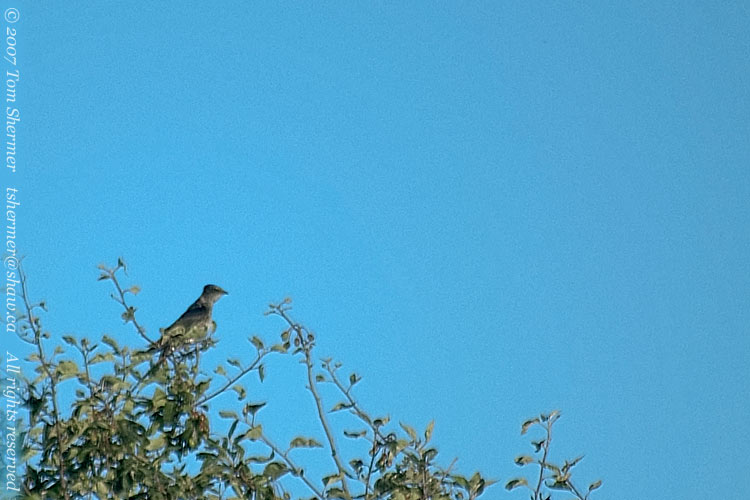
I continued around the trail a little more, and then I noticed a bird in the top of a tree, near the place where I had gotten the photo of the Bonaparte's Gull. I puzzled over its identity for a little while, running through all the tree-top-perching birds that were likely for the spit. None of them really fit with what I was looking at, though.
The bird looked like a swallow, but it was fairly big. There happens to be one big North American swallow species, which is about 50% longer (somewhere around twice the size, visually) than all the others: the Purple Martin. There are only one or two places I know of to go and see Purple Martins around the lower mainland, and Blackie Spit isn't one of them. Nevertheless, this was definitely a Purple Martin, and I was definitely at Blackie Spit. |
|
 |
This was turning into a very nice trip. As if two good birds wasn't enough fun, the next thing I know I was looking over at a scruffy geologist who was headed my way. I hadn't been expecting to see any geologists, and I hadn't been expecting to see anyone scruffy, so this was a doubly-pleasant surprise. The particular scruffy geologist who was headed my way is usually called Carlo.
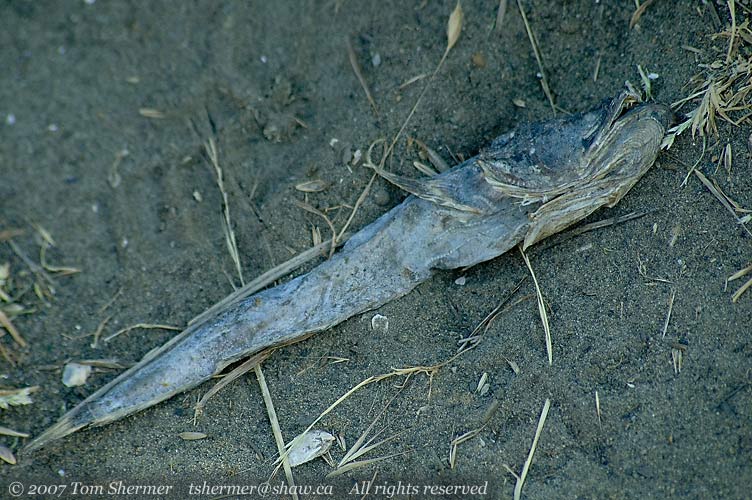
Carlo and I chatted for a while, and he pointed out some lovely dead fish on the shore that I had overlooked.
|
|
 |
Carlo hadn't seen the Purple Martin, and I hadn't had a chance to mention it to him. But while we were talking, he heard the martin and spun around to look for her. I hadn't heard a thing, of course, but I'm always impressed when people identify birds by sound. Particularly when it's sound I can't hear. It's like they're psychic or something.
We next walked back over to where the martin and the Bonie were. A very striking moth was flitting around in the vegetation there, and I did my best to get a picture of it. |
|
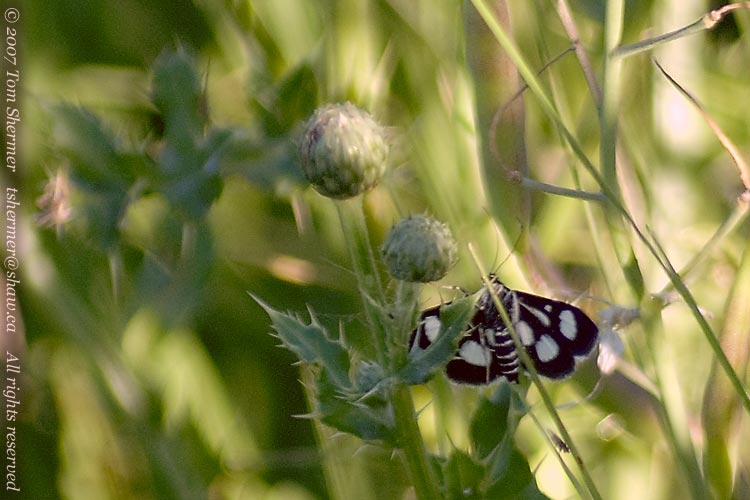 |
That moth is Anania funebris, the White-Spotted Sable Moth.
Carlo had also come to the spit to try to see Bill Curley, who had supposedly been hanging around the spit for about a week, although neither Carlo nor I had heard about him until that morning.
It turns out we were in luck. We hopped a little creek, followed the shore a short ways, and then spotted Curley coming the other way along the shore towards us. |
|
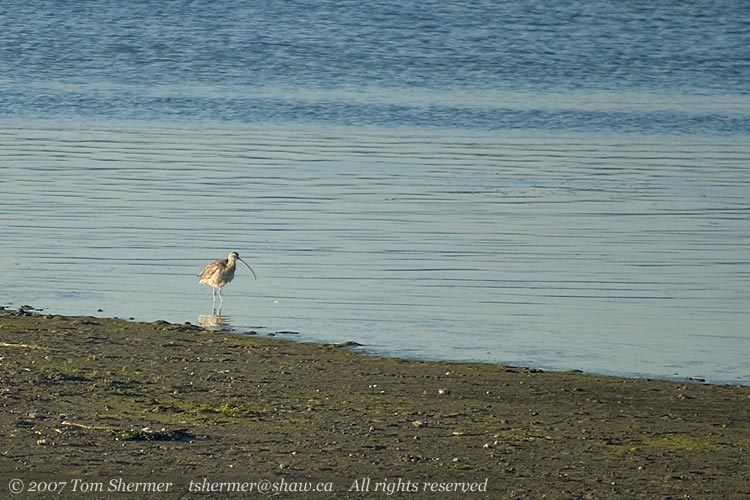 |
| When we got a little closer, "Long Bill" stopped to show off his most impressive feature to us. |
|
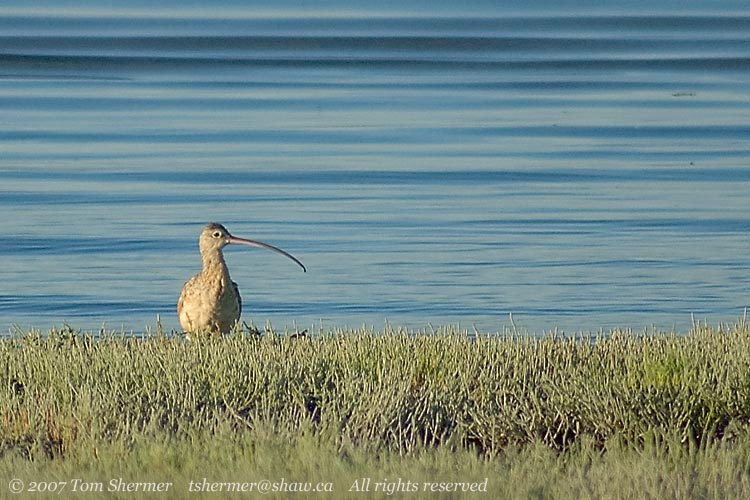 |
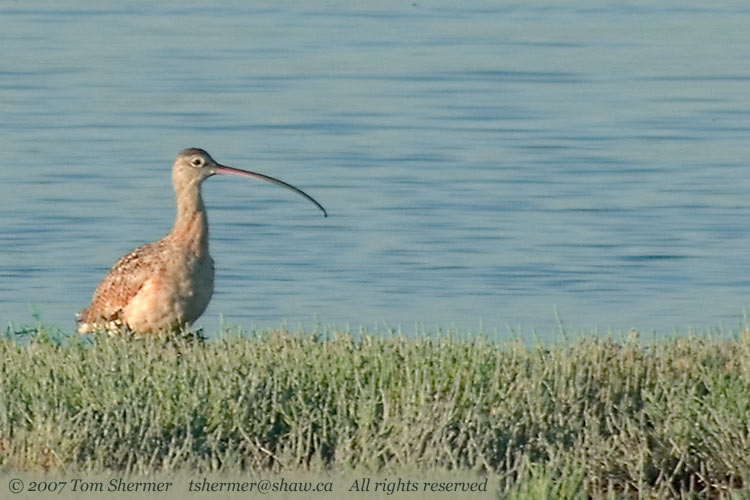
He's named for that feature: Long Bill Curley is a Long-billed Curlew. I find it easy to identify Long-billed Curlews because they have a long bill and it's curly.
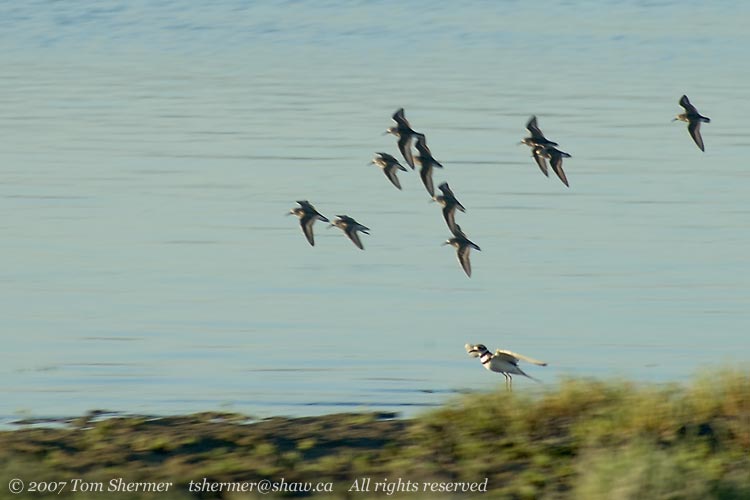
We spent maybe a half-hour watching and photographing our bird, and talking with another photographer who was there. At one point, some smaller shorebirds flew in: a few peeps and a Kildeer. |
|
 |
| But other than that, there wasn't any excitement. The curlew wasn't doing much while we watched...mainly he was just watching us back. |
|
 |
Sometime around 8:15, Bill packed it up and went flying across the water towards Mud Bay. Bereft of our subject, Carlo and I called it a day.
Amongst other things, I'd gotten three good birds and a cool new moth, which is not too shabby for a short evening out.
Your friend of scruffy psychic geologists,
Tom
|
|
|